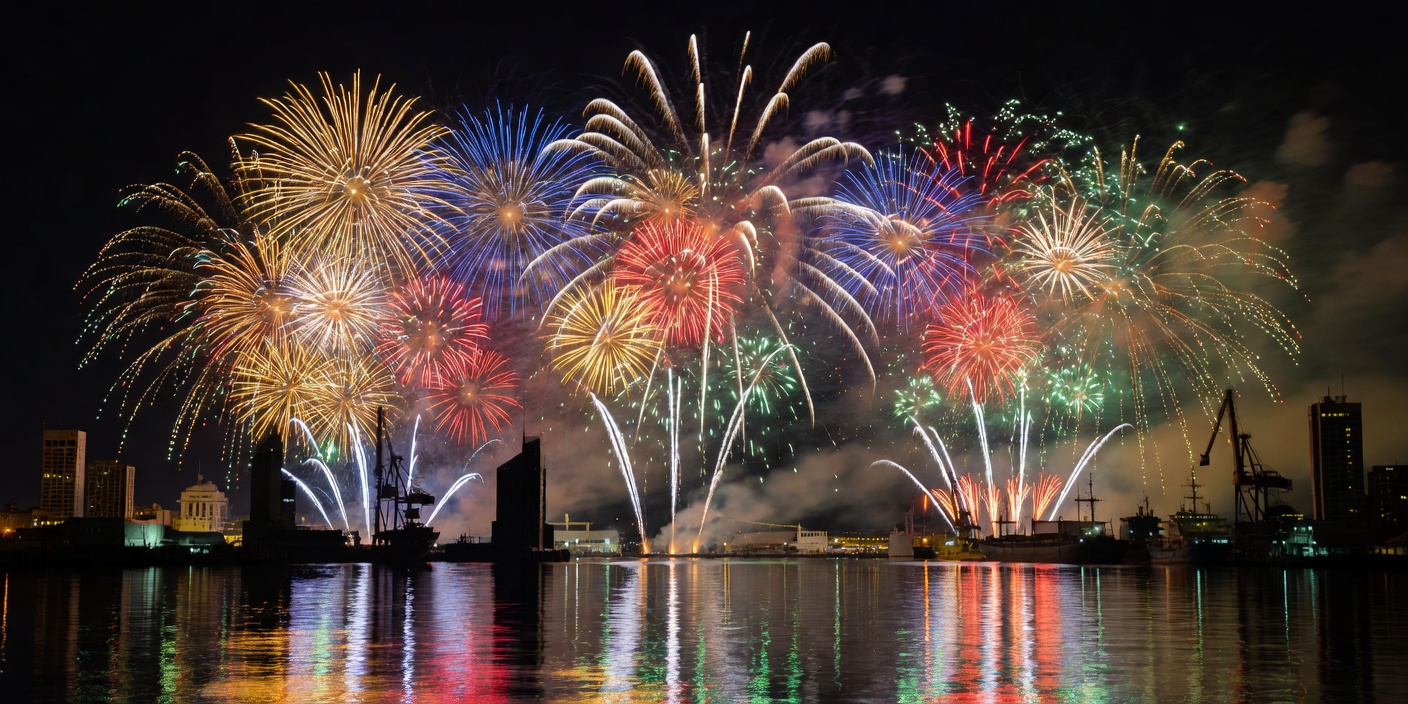
Sydney’s New Year's Eve celebration represents the undisputed summit of municipal pyrotechnic engineering. Orchestrating an 8.5-tonne display spanning an iconic steel through-arch bridge, four 130-foot maritime barges, and seven surrounding harbor rooftops requires solving exceptional civil engineering challenges.
1. Bridge Deck Thermal Stress & Rigging Architecture
The Sydney Harbour Bridge contains roughly 53,000 tonnes of structural steelwork. Attaching thousands of high-temperature pyrotechnic effects directly to heritage-listed steel requires specialized non-destructive clamp assemblies. Welding or drilling is strictly prohibited by transport authorities.
Our engineers designed ceramic-insulated aluminum bracket fixtures lined with high-density vermiculite thermal barriers. These units dissipate the 1,400°C ignition back-blast of fast comets without conducting measurable thermal expansion into the primary tension hangers.
2. Harbor Tidal Surge & GPS Anchoring Matrix
Unlike fixed dry-land firing lines, marine barges are subject to multi-directional oceanic swells, wind drift, and tidal currents. An unintended 5-meter shift in barge orientation would turn an angled waterfall effect directly into a spectator ferry cordon.
- Four-Point Spud Leg Mooring: Heavy industrial steel spud legs are driven into the harbor substrate, locking barge heave and yaw motion to within ±0.3 degrees.
- Differential GPS Telemetry: Continuous positioning beacons report barge pitch and roll angles back to the master firing desk every 200 milliseconds. If wave swell produces a roll exceeding 4.5 degrees, high-caliber salvo cues are automatically held in pause mode.
3. Underwater Armored Optical Fiber Link
Wireless transmission across Sydney Harbour during NYE faces catastrophic electromagnetic clutter caused by over one million mobile phones, television broadcast uplinks, and police communications. Relying on RF transmission alone introduces unacceptable risk.
A tactical 12-core armored subsea optical cable connects the central control bunker on the northern pylon directly to each marine barge. This provides zero-latency timecode synchronization unaffected by atmospheric RF saturation.